
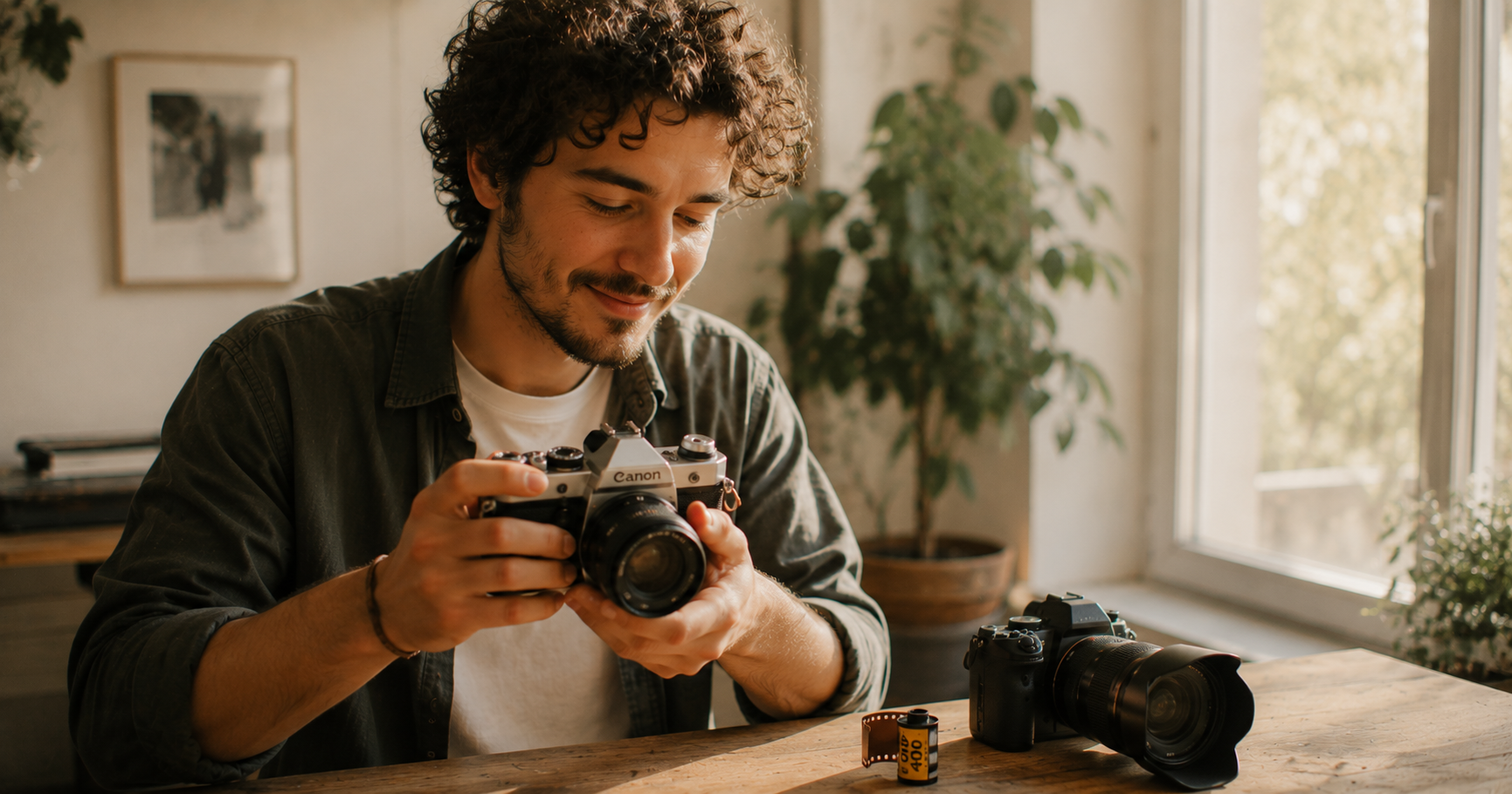
Why film and analog photography are getting a second life in 2026
Anyone who predicted ten years ago that photographers in 2026 would be visiting the film shop more than ever would have been laughed at. And yet Kodak is back in the black, Ilford is expanding its product line, and in cities like Berlin, Tokyo and Amsterdam small labs are opening that develop rolls for a new audience. For a craft that had been written off as 'finished' for twenty years, that is remarkable. What is behind it, and is it worth trying as a digital photographer? I wrote earlier about my own struggle with analog photography. This article looks wider: why the medium is coming back, and what it could bring you as a digital photographer.
The fatigue of perfect
One major driver is reaction. Digital photography has become more technically capable than ever. High ISOs without noise, dynamic range that used to require multiple exposures, autofocus that finds eyes through branches. Wonderful, and at the same time a little exhausting. When everyone can make sharp, clean photos, the search for something different begins. Film gives you that something different almost automatically. Grain, color characteristics that no preset can fully replicate, a quality that feels found rather than produced. For portrait photographers who want to distinguish their work, for street photographers looking for a rawer aesthetic, for family photographers who want to give clients something that ends up in a box in the attic and not just on a hard drive, film offers something digital does not copy.
The calm of limitation
A roll has 24 or 36 frames. You count every frame. You look longer before you press the shutter. You set your shutter speed, aperture and focus yourself, without your camera thinking along about what it thinks you want. Many photographers who started with film discover that it also makes them shoot digital better. The eye sharpens. Composition becomes calmer. You learn to slow down between seeing and pressing. A few months shooting only film seems to work as a reset button for some people's entire way of working.
The business side of analog
The return of film does not mean it is cheap. A roll of color film costs around ten to fifteen euros, and developing plus scanning adds to that. A shoot of five rolls means a hundred euros in materials before you have delivered a single photo. Some photographers pass that cost on, offering film shoots as a premium product. Others mix it in: a main digital shoot with a few rolls of film for key moments. In both cases, analog is used to give the work value, not to save money. Anyone wanting to get started does not need to switch everything over at once. A secondhand SLR from the eighties, a good lens, a few rolls of Portra or HP5, and you can get going for less than the price of a new lens. More important than which camera you use is finding a lab nearby that develops your work reliably.
What film does not give you
To be honest: film is not better than digital. It is different. For sports photography, for fast-paced work, for situations where you need two hundred photos and have to deliver two of them, digital remains the right choice. For events, for commercial jobs with tight deadlines, for product photography, the same applies. Film works where time and feeling can come together. A portrait session where you have the space to work slowly. A personal project where you are looking for your own tone. A trip from which you do not want to bring back five thousand photos but thirty that actually say something.
And the hybrid approach
The most common story in 2026 is not 'I only shoot film' or 'I am sticking with digital'. It is the combination. Digital for the work, film for the heart. Digital for the assignment, film for the project. Digital for volume, film for the moments where you want to give extra care and weight. For photographers who want to keep developing their work, not just technically but also in tone and direction, film offers a valuable parallel path. It is not a retro trend. It is a way to bring the fundamentals of the craft back within reach in an era where everything is getting smarter, faster and more automated. Start small. Pick up a roll, shoot with intention, get it developed, look carefully at what comes back. There is a good chance it will teach you something about yourself as a photographer that your digital work has not touched in a while.